Written by Flo, founder of Carbsnap. This guide is educational and is not medical advice — your diabetes care team's guidance always comes first.
If you were diagnosed with diabetes recently, someone has probably told you to "count your carbs" — and then handed you surprisingly little instruction on how to actually do it while standing in your kitchen looking at a plate of food.
This guide is the missing instruction. It's written for the first few months, when everything is new and every meal feels like a quiz you didn't study for. It gets easier. Here's how to make it easier faster.
Why carbs, specifically?
Of the three macronutrients — carbohydrates, protein, and fat — carbohydrates are the one that raises blood sugar quickly and substantially. Protein and fat matter for overall health and can affect blood sugar slowly and modestly, but carbs are the main event.
That's why insulin dosing is built around carbs. If you use mealtime insulin, your care team will give you an insulin-to-carb ratio (ICR) — something like 1:10, meaning one unit of rapid-acting insulin for every 10 grams of carbohydrate you eat. The math only works if the carb number going into it is roughly right:
- Guess 30g when the plate is really 50g → too little insulin → high blood sugar later
- Guess 50g when it's really 30g → too much insulin → risk of a low
You don't need to be perfect. Experienced carb counters — including dietitians — are typically within 10–20% of the true number. The goal is close enough, consistently, without it taking over your life.
What actually has carbs (and what doesn't)
High-carb foods: bread, rice, pasta, potatoes, tortillas, cereal, oatmeal, beans and lentils, corn, fruit and fruit juice, milk and yogurt, anything sweetened, and most snack foods.
Low- or no-carb foods: meat, poultry, fish, eggs, cheese, oils and butter, and most non-starchy vegetables (leafy greens, broccoli, peppers, cauliflower, zucchini).
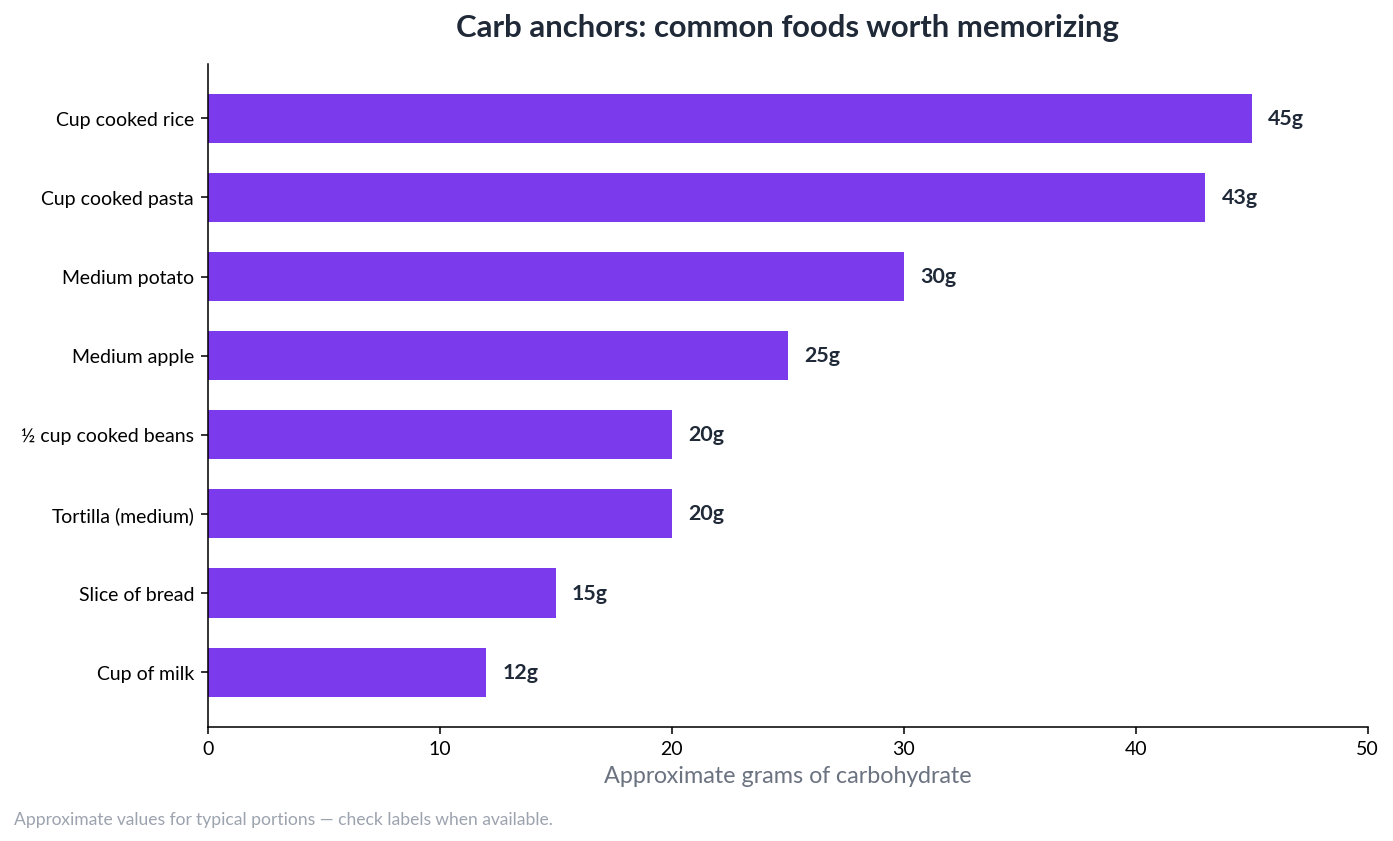
The ones that surprise people: milk (~12g per cup), fruit (a large apple can be 25–30g), beans (~20g per half cup, though slow-acting), breading on fried foods (10–20g), sauces — especially tomato-based and Asian-style sauces (5–20g), and "healthy" items like granola, smoothies, and açaí bowls, which can out-carb a dessert.
The three ways to get a carb number
1. Read the label. Packaged food tells you. Two habits: look at total carbohydrate (not just sugar), and check the serving size — the bag is often 2.5 servings, not one.
2. Look it up. For unpackaged single foods — a banana, a cup of rice — any nutrition database gets you close. A handful of anchors, memorized early, covers a surprising share of everyday meals:
3. Estimate the plate. This is the hard one, and it's where most real meals live — mixed dishes, home cooking, restaurants. The classic methods are hand comparisons (a fist ≈ 1 cup) and mental portioning. The modern method is photo estimation: apps like Carbsnap let you photograph the plate and get a carb estimate in a few seconds. (Full disclosure: I built Carbsnap, with dietitians, for exactly this moment — and the carb-counting feature is free forever, because a newly diagnosed person shouldn't have to subscribe to figure out dinner.) Whatever tool you use, treat it as a well-informed estimate to sanity-check against your own developing judgment — not an oracle.
The three mistakes almost everyone makes at first
Mistake 1: Eyeballing portions optimistically. That "cup" of rice is usually a cup and a half — which is 20+ extra grams. Fix: measure your common foods once or twice, not forever. After a week of occasionally weighing rice and pasta, your eyes recalibrate and stay reasonably calibrated.
Mistake 2: Missing the hidden carbs. The chicken is 0g, but its breading isn't. The salad is 5g, but the dressing and croutons aren't. Sauces, marinades, and "just a little" sides add up quietly. Fix: scan the plate once and ask "what here came from a grain, a root, a fruit, or a bottle?"
Mistake 3: Confusing cooked and dry. One cup of dry rice becomes about three cups cooked — same total carbs, very different volume. Recipe carb counts often reference dry weights. Fix: know which state your number refers to. When in doubt, estimate from the cooked portion in front of you.
A realistic learning curve
- Weeks 1–2: everything feels slow. Look things up constantly. That's normal, not failure.
- Weeks 3–6: your regular meals become known quantities. You look up maybe 20% of what you eat.
- Month 3+: estimation becomes semi-automatic, and tools are for the unfamiliar — restaurants, travel, someone else's cooking.
Two more things worth doing early: track your accuracy, not just your carbs (when a post-meal reading surprises you, revisit the estimate — that feedback loop is how you improve), and bring your care team into it. If you work with a dietitian or diabetes educator, ask them to spot-check your estimates for a week. It's the fastest calibration available.
The mindset that makes this sustainable
You will get numbers wrong. Everyone does — newly diagnosed or twenty years in. The point of carb counting isn't perfection; it's making your insulin and food decisions informed instead of blind. A rough number beats no number, every meal, every time.
Be patient with yourself. This is a skill, and like every skill, it's clumsy before it's automatic.
Tools can shorten the learning curve. If you want to see what photo-based carb counting feels like, Carbsnap is free on the App Store and Google Play — snap one meal, no signup required. And if you're comparing options, we wrote honest comparisons with MyFitnessPal and Carb Manager, plus a roundup of the best carb counting apps.
This article is for education only and isn't medical advice. Always follow your diabetes care team's guidance on insulin dosing and diet.