Written by Flo, founder of Carbsnap. I make a photo carb counter, so I have an obvious interest in you believing they work — which is exactly why this post includes the parts where they don't.
Every photo-AI nutrition app makes the same implicit promise: point your camera at a plate, trust the number. If you're counting carbs for insulin dosing, that promise deserves scrutiny, not marketing. So let's scrutinize it properly — starting with the question almost nobody asks first.
Accurate compared to what?
The honest baseline for a carb counter isn't perfection. It's you. And human carb estimation has measurable, predictable failure patterns.
Before Carbsnap was an app, it was a carb-counting practice platform: dietitians and regular users estimated carbs on thousands of real meal photos so they could sharpen their skills, and we compared their answers. Three findings from that research (originally published on our old insights site, now moved into this blog) still shape how we think about accuracy:
People dramatically underestimate carbs in fruits and vegetables. On one fruit-and-vegetable plate in our dataset, the dietitian consensus was a median of 135g; patients' median estimate was 50g — less than half. "It's healthy" gets mentally filed as "it's low-carb," and for someone dosing insulin, that's a miss measured in mmol/L.
People overestimate carbs in meats. Patients assigned meat dishes about 2.5g more carbs than factual on average — and on individual plates the gap was striking: one dish the dietitians put at 0–5g drew patient estimates with a median of 20g. Protein gets carb-taxed in people's heads.
People are surprisingly good at pasta. Per-picture average errors mostly fell between −2g and +1.5g, with dietitian and patient estimates closely aligned. Our read: pasta is high-carb (~59g average in our photos), consequences of misjudging it are immediate, and people learn what matters to them.
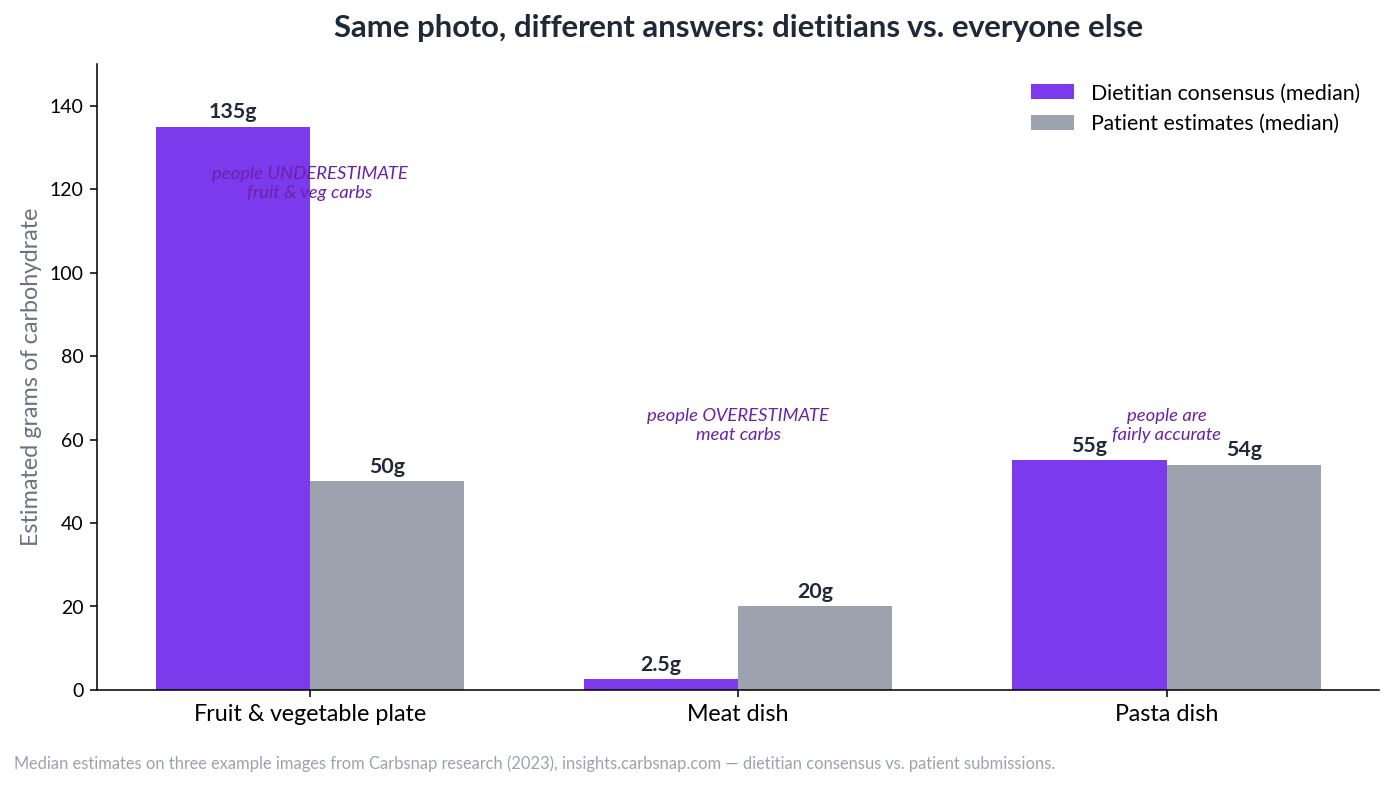
The pattern matters more than the numbers: human error isn't random noise — it's systematic bias by food category. Even experienced counters and dietitians typically land within 10–20% of the true value, not on it. Any tool claiming to help should be judged against that reality, not against a lab scale.
How we tested Carbsnap
Carbsnap's AI was built on exactly that research foundation. The dietitians who rated thousands of meal photos gave us something rare: a consensus benchmark — for any given plate, what does a panel of professionals converge on? That's the standard we measure the AI against, because for real-world mixed meals there often is no single "true" number, only the range professionals agree on.
We presented this accuracy methodology at the 2025 American Diabetes Association Scientific Sessions — the main scientific venue for diabetes research. The one-line summary: on our evaluation photos, Carbsnap's estimates are comparable to dietitian consensus. Not better than dietitians. Comparable — in about three seconds, on the plate in front of you, including the mixed and home-cooked dishes that are miserable to look up in a database.
Given the human-bias data above, "comparable to a dietitian" is a meaningful claim: it means the app doesn't share your blind spots. It won't halve the carbs on a fruit plate because fruit feels healthy, and it won't invent 20g in a steak.
Where photo AI fails — including ours
This is the section marketing pages leave out. A single photo fundamentally cannot see everything, and you should know the failure modes before you dose off any app's number:
Hidden ingredients. Sugar stirred into a sauce, oil absorbed during frying, sweetened dressings — invisible to any camera. A photo estimator infers from what's visible and typical; an atypical recipe beats it.
Depth and density. A photo flattens the third dimension. A shallow bowl of rice and a deep one can look similar from above. Angles help, but volume estimation from one image is genuinely hard — this is where the biggest single-item errors come from.
Buried components. The tortilla under the pile, the rice beneath the curry. If a human can't see it in the photo, neither can the model.
Liquids. Sweetened drinks, smoothies, and soups are estimation minefields — the carbs are in solution, not in view.
Because these failure modes are real, Carbsnap lets you edit the description and re-estimate: if the app read your plate as plain chicken and rice but the sauce is sweet, you tell it, and the estimate updates. The photo is the starting point, not the verdict.
How to actually use one (especially with insulin)
Treat any photo estimate — ours included — as a well-informed second opinion, and build a habit around it:
- Sanity-check against anchors. A cup of cooked rice ≈ 45g, a slice of bread ≈ 15g. If the estimate wildly disagrees with the anchors you can see on the plate, investigate before dosing.
- Close the loop. When a post-meal reading surprises you, revisit the estimate. Your glucose meter is the ultimate accuracy audit, and it's auditing you and the app equally.
- Know when to reach for other tools. Barcode + label beats any photo for packaged food. A food scale beats everything when precision matters most (new insulin ratios, tricky foods). Photo AI wins on the plates where labels and scales are useless: restaurants, family dinners, anything mixed.
- Keep your care team in it. If you work with a dietitian or diabetes educator, ask them to spot-check your estimates — theirs is the consensus the tools are chasing anyway.
The bottom line
Photo carb counters are not oracles, and anyone selling one as an oracle is selling badly. The fair claim, backed by our research and the methodology we presented at ADA: human carb estimation has large, systematic biases; a well-built photo AI can land in the dietitian-consensus range in seconds without those biases; and it fails in knowable places you can check for. That combination — fast, unbiased-by-food-category, and correctable — is what makes it useful for real life with diabetes.
Judge it yourself on your own plate: Carbsnap's carb counting is free forever on the App Store and Google Play — snap one meal, no signup required. Then check it against whatever you trust most.
New to carb counting? Start with How to Count Carbs When You're Newly Diagnosed. Comparing tools? See The Best Carb Counting Apps in 2026.
This article is educational and isn't medical advice. Always follow your diabetes care team's guidance on insulin dosing.