Written by Flo, founder of Carbsnap. Carbsnap is one of the apps in this comparison, so read me with the same skepticism you'd read any of them — every claim about a competitor below links to that company's own pricing page or App Store listing, checked September 14, 2026. Prices change; the links are the source of truth.
Type "carb counting app" into a search engine and every result says the same thing: free to download. That phrase is doing a lot of work. Downloading is free the way walking into a restaurant is free — the question is what happens when you try to eat.
If you count carbs because you dose insulin, this isn't a shopping annoyance, it's a planning question: which features can you rely on next month, after the trial ends, without a card on file? So we read the fine print on seven apps. Here's what's actually free.
The short version
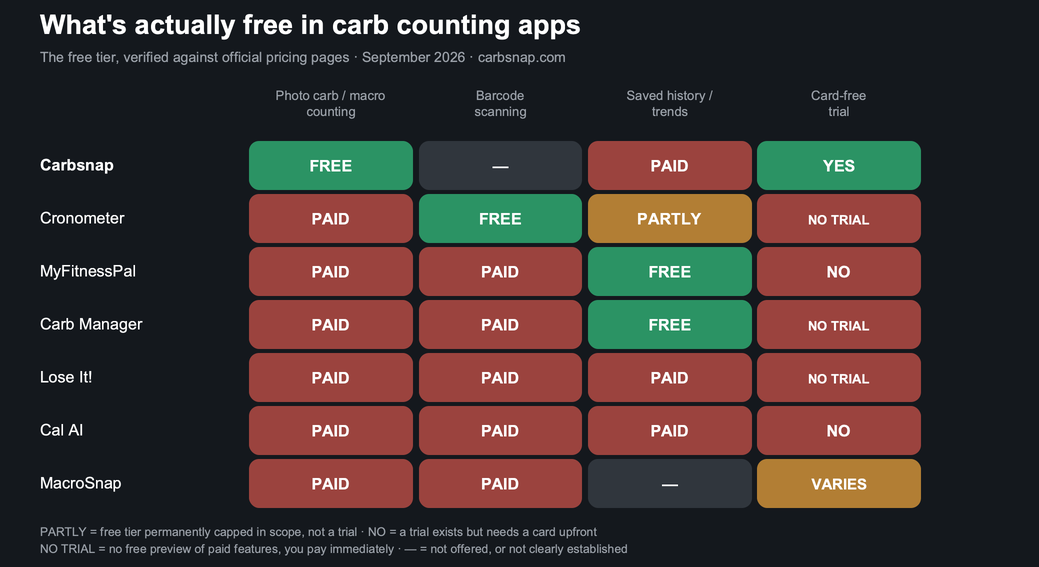
| App | Actually free | Behind the paywall | Paid price |
|---|---|---|---|
| Carbsnap | Photo carb counting plus calories and full macros — free forever, no account, no card | Meal history & trends (Plus) | $4.99/mo or $39.99/yr, 7-day trial (no card needed) |
| Cronometer | Manual logging, barcode scanning, 84 nutrients, 7-day history | Photo logging, voice, history beyond 7 days | $10.99/mo or $59.99/yr |
| MyFitnessPal | Manual/search logging, with ads | Barcode scanning and photo Meal Scan, custom macros | $79.99/yr, 7-day trial |
| Carb Manager | Manual logging, weight, community recipes | Photo logging, barcode, voice, meal plans | $3.33/mo billed annually |
| Lose It! | Calorie tracking, weight-loss plan | Carb/macro tracking itself, photo logging, barcode | Premium subscription (tiers vary) |
| Cal AI | Effectively nothing — "food scanning analysis results require a subscription" | All scanning | ~$29.99/yr tiers, 3-day trial |
| MacroSnap (3 different apps!) | One version: limited scans. Other two: nothing | Scanning, plans | $4.99–7.99/mo |
Two patterns jump out of that table, and they're worth naming before the app-by-app detail.
Photo logging is paywalled in every mainstream app. MyFitnessPal, Carb Manager, Cronometer, and Lose It! all reserve photo-based logging for their paid tier, and Cal AI and the MacroSnap apps require a subscription for scanning outright. If pointing your camera at a plate is the feature you want, the industry's answer in 2026 is: that'll be a subscription. (Carbsnap is the exception, deliberately — more on that at the end.)
Even barcode scanning — the cheapest feature there is to run — is mostly paid now. MyFitnessPal moved its barcode scanner behind Premium in October 2022 and it remains Premium-only on the official comparison table today. Lose It! and Carb Manager list it as a premium feature too. Cronometer is the honorable exception: barcode scanning is free.
App by app
Cronometer — the most generous mainstream free tier
If you want a traditional manual tracker without paying, Cronometer is the strongest free tier in the group: logging, custom macro targets, barcode scanning, and tracking for 84 nutrients, all free. The catches: reports and history are limited to a rolling 7-day window, photo and voice logging are Gold-only, and the free tier is ad-supported. Gold runs $10.99/month or $59.99/year. For a person with diabetes who wants long-term pattern data, the 7-day history window is the real limitation.
MyFitnessPal — free to log by hand, paid to scan anything
The free plan never expires and covers manual and search-based logging (with ads). But both barcode scanning and the photo "Meal Scan" sit in Premium, at $79.99/year, along with custom macro targets. The 7-day trial auto-converts: "the first charge will take place at the end of your trial unless you cancel before then." Worth knowing: MyFitnessPal acquired Cal AI in late 2025, so the two are now one company.
Carb Manager — keto-focused, logging conveniences paid
The free Basic account covers manual food/exercise/weight logging and community recipes. The three fast ways to log — photo, barcode, and voice — are all marketed as Premium features, at $3.33/month billed annually. It's the cheapest paid tier in this list, and the free manual tracker is workable if you don't mind typing.
Lose It! — read this one twice
Lose It!'s free tier covers calorie tracking and a personalized weight-loss plan. But per its own App Store listing, the premium plan is where you get "Advanced Tracking — track macronutrients like protein, carbs, fat, sugar" — along with photo meal logging and the barcode scanner. In other words, for a carb counter specifically, Lose It!'s free tier doesn't count carbs. Premium pricing varies by plan tier on the listing.
Cal AI — a trial, not a free tier
Cal AI is the most-downloaded photo calorie app, and its own App Store listing is candid: "food scanning analysis results require a subscription." There's a 3-day trial, after which billing starts automatically — the FAQ warns that deleting the app does not cancel the subscription. Two more facts for informed shopping: the company's own FAQ states the AI is "about 80% accurate," and in April 2026 Apple briefly removed Cal AI from the App Store over deceptive billing design — including showing a weekly-equivalent price more prominently than the amount actually billed — before it was restored with fixes (9to5Mac's report).
MacroSnap — check which one you're downloading
Here's a consumer-confusion trap: there are at least three separate apps using the MacroSnap name, from three different developers. MacroSnap AI by With Bytes states plainly that "a subscription is required to use MacroSnap AI" (it's the one sold as a $39.99 lifetime deal on StackSocial). A different MacroSnap – AI Calorie Tracker says "food scanning and personalized plans require a paid subscription" ($4.99/mo or $29.99/yr). A third, MacroSnap by RANDM, does offer a free tier with limited AI scans, with unlimited scanning at $7.99/month. If a friend recommends "MacroSnap," you have roughly a one-in-three chance of downloading the app they meant.
Carbsnap — what "free forever" means here
Full disclosure again: this is us. In Carbsnap, photo carb counting is free forever — point the camera at the plate, get the carb estimate in about three seconds. And it's not carbs alone: the same free photo result includes calories, protein, and fat, so the free tier is a complete macro reading, not a teaser. No account, no payment method, no trial that quietly converts. That's not a promotional tier; it's the reason the app exists: our family built it after our daughter's type 1 diagnosis, and a newly diagnosed family shouldn't have to subscribe to figure out dinner.
What we do charge for: Carbsnap Plus ($4.99/month, or $39.99/year) adds saved meal history and trends, and a practitioner dashboard lets dietitians review patients' logged meals — patients connected to a practitioner get the full app included. A 7-day free trial (no card required) unlocks that same history early if you want to try it before subscribing; after the trial, it locks again — nothing is deleted, it's just not viewable — until you subscribe. The counting itself never touches a paywall or a trial. Judge the accuracy claims the same way you'd judge anyone's: our data is public, presented at the 2025 ADA Scientific Sessions, failure modes included.
Three fine-print rules for any nutrition app
1. "Free to download" ≠ free to use. The two most useful questions: what happens on day 8, and does the core feature I want work without a card on file? For five of the seven apps above, photo logging fails that second test.
2. Know your trial mechanics before you start one. Cal AI's trial is 3 days and auto-converts; MyFitnessPal's is 7 and auto-converts. Neither is unusual — auto-converting trials are the industry default, which is exactly why regulators and Apple have been paying attention to how they're presented. Set a calendar reminder the moment you start any trial.
3. Free doesn't matter if the numbers are wrong. A July 2026 study by NIH researchers tested four photo-calorie apps against 100+ precisely weighed meals and found all four underestimated calories by 250–345 on average, with the worst accuracy on high-fat meals (presented at NUTRITION 2026; not yet peer-reviewed). Accuracy varies by app and by food category — we wrote an honest deep-dive on where photo carb counters fail, including ours. And the American Diabetes Association's carb counting guidance is a good grounding regardless of which tool you use — apps help you calculate; they don't replace knowing what you're looking at.
FAQ
Are carb counting apps free? Most are free to download and free for manual logging. The convenient logging methods — photo and barcode — are paid features in nearly every mainstream app in 2026. Carbsnap (photo carb counting) and Cronometer (barcode + manual) are the notable free exceptions, each free in a different way.
What's the best completely free carb counting app? Depends on the feature you need. For photo-based counting with no account at all — carbs, calories, and macros from one photo: Carbsnap (that's us — verify with a free download). For a full manual tracker with barcode scanning and micronutrients: Cronometer's free tier, if you can live with 7-day history.
Do carb counting app free trials charge you automatically? Most do. MyFitnessPal, Cal AI, and one MacroSnap app all auto-convert to a paid subscription unless you cancel before the trial ends — and deleting the app does not cancel the subscription. Cancel via your phone's subscription settings, not the app. Carbsnap's own 7-day trial (for saved history) is the exception: it doesn't ask for a card, so there's nothing to auto-convert — it just locks again until you subscribe.
Is there a free carb counting app for type 1 diabetes? Carb counting itself is the same skill regardless of diabetes type — see the ADA's guidance. If you're newly diagnosed, our guide to counting carbs after diagnosis covers the skill; any app is a calculator, and for insulin dosing decisions your care team's advice comes first.
Related: Best carb counting apps in 2026 · Carbsnap vs Carb Manager · Carbsnap vs MyFitnessPal · How accurate are photo carb counters?
All prices and feature claims checked September 14, 2026 against the linked official pages. If you spot something that's changed, tell us and we'll correct it.